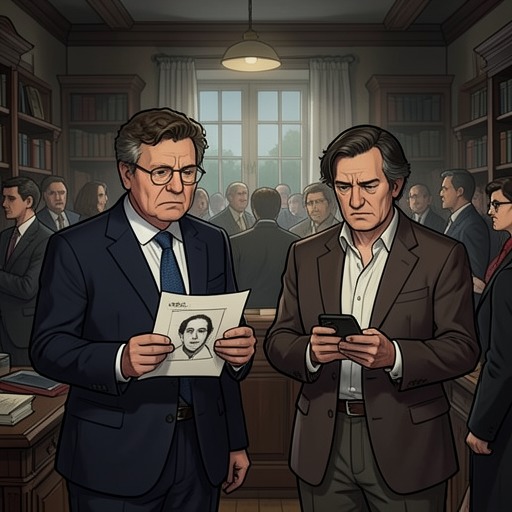
Victoria's accusation against Fonny
If Beale Street Could TalkVictoria Rogers’s accusation against Fonny places their relationship at the center of a case whose consequences reach far beyond the two of them. Her identification supports the prosecution and keeps Fonny in prison, while the circumstances in which she says she recognized him remain disputed. The book does not supply an independent resolution of that dispute: instead, it shows how testimony, constrained access to other witnesses, and the disappearance of the accuser shape the family’s efforts to secure Fonny’s release.
The accusation and the case
Victoria’s testimony is a central obstacle for Hayward, Fonny’s lawyer. When Victoria refuses to reconsider her account and then disappears, Hayward tells Tish and Sharon that the prosecution has gained a serious advantage. Finding Victoria would require special investigators and money, turning the search for one witness into a direct financial burden on the family. Sharon recognizes the cost immediately. The legal case is therefore not confined to what Victoria says happened; it also dictates whether the family can afford to pursue the person whose testimony sustains the charge.
The accusation operates within a broader contest over whose account the legal system will credit. Hayward believes Fonny is innocent and describes Officer Bell as racist, but explains that belief alone cannot determine the outcome: the contest is over who wins. Tish and Fonny maintain that they were together in a room on Bank Street with Daniel Carty. Yet Hayward warns that Tish’s testimony counts for little, while Daniel has been arrested by the District Attorney’s Office and held incommunicado, beyond Hayward’s access. Hayward suspects that officials intend to pressure Daniel to change his testimony, and believes Victoria’s disappearance may also be connected to the prosecution’s actions. He presents that connection as a suspicion, not established fact. In this imbalance, Victoria’s identification gains force as other supporting testimony is obstructed or discounted.
What Victoria says she saw
Sharon travels to Puerto Rico to find Victoria and approaches her as the future mother-in-law of the man Victoria has accused. Their exchange exposes a sharp disagreement about identification. Sharon argues that the alleged assault occurred in darkness and that Fonny was seen under the lights of a police lineup. Victoria answers that she was taken to the lineup, asked to choose, and selected him; when Sharon presses the distinction between that identification and seeing the person who attacked her, Victoria says there were lights in the hallway and that she saw enough.
Those statements leave the evidentiary conflict visible rather than settling it. Victoria maintains that she recognized Fonny, while Sharon treats the lineup as the first and only occasion on which Victoria saw him. The difference matters because the accusation depends on the identification, but the two women give opposed accounts of what Victoria could have seen and when. The narrative records both Victoria’s assertion and Sharon’s challenge without supplying a separate witness who resolves their disagreement.
Sharon’s appeal and Victoria’s departure
During the confrontation, Sharon tries to reach Victoria through their shared position as mothers and through the photograph of Fonny and Tish that she has brought with her. She reminds Victoria that Fonny is young, wants to marry her daughter, and is Black. That appeal makes the accusation personal and familial, but it does not produce agreement. Victoria insists that she knows the man who harmed her; Sharon asks whether she can be sure of that knowledge.
The encounter breaks down when Sharon touches Victoria’s crucifix and invokes God. Victoria screams, runs from the room, and calls for Sharon to leave. People emerge into the hallway; an older woman takes Victoria in her arms as she weeps and leads her away. Sharon leaves carrying the photograph of Fonny and Tish. The scene ends not in reconsideration or clarification, but in separation: Sharon has reached Victoria, yet has not persuaded her to withdraw or revise her identification.
Consequences for Fonny and his family
The disappearance that follows removes the prosecution’s principal witness from reach. Later, Sharon reports that Victoria has been taken to the mountains, to a place called Barranguitas, and that Jaime believes she will never be seen again. The account establishes where she has been taken as Sharon reports it, but does not explain who arranged her removal or why. With Victoria unavailable, the prosecution’s case changes sharply; the family sees a slim remaining hope in Daniel, who has himself been transferred to an upstate prison and cannot be located by them.
The disappearance does not immediately free Fonny. The prosecution is expected to ask for more time, while the family plans to seek dismissal of the charge and must also prepare for the possibility of bail if the state agrees and they can raise the money. The accusation thus continues to govern the family’s choices even after its principal witness is gone. For Tish, the legal delay exists alongside pregnancy and the prospect of having to keep working as her condition advances. Her thoughts about surviving if Fonny remains imprisoned show how the case presses into ordinary labor, bodily uncertainty, and the family’s economic limits.
Narrative significance
Victoria’s accusation is presented both as an individual claim and as a force reorganizing the lives of others. Fonny’s imprisonment separates him from Tish as their child’s birth approaches; the effort to find Victoria demands money; and the restrictions surrounding Daniel limit the family’s ability to support its account. The story does not treat the accusation’s importance as proof of its truth. Instead, it keeps attention on the difference between what Victoria says she saw, what Sharon believes she could have seen, and what the legal system is prepared to do with testimony while other witnesses are inaccessible.
That unresolved difference makes the relationship consequential without making it reciprocal: Victoria’s identification determines the course of Fonny’s case, though the evidence presented does not establish a personal relationship between them before the accusation. Her disappearance removes one source of testimony but leaves the imprisonment, the uncertainty, and the family’s struggle for release in place.